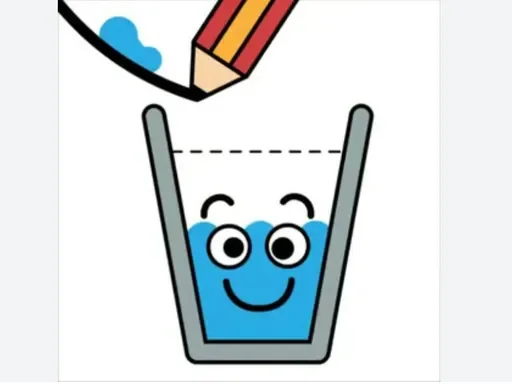
Happy Glass

Rating:
4.27
Played:
12,880
What Is Happy Glass
Happy Glass is a drawing puzzle where each level begins with the same emotional setup: a sad empty glass and a water source that cannot reach it on its own. Your task is to draw lines that change the path of water so the cup fills to a target mark. The idea is simple in seconds, but the game quickly turns that simplicity into clever spatial problems.
Most stages are short. You sketch, watch the water flow, and immediately see whether your plan works. If it fails, you erase and retry. This quick cycle gives Happy Glass its momentum, because every attempt teaches you something concrete about angle, gravity, and timing.
Why players stick with it
Happy Glass feels approachable for new players and still satisfying for puzzle fans. The controls ask very little, but the outcomes depend on precision. A line that is slightly too steep can spill everything. A small wall placed too late can bounce water away from the cup. That balance between easy input and meaningful consequence is the core of the game.
How the Core Loop Works in Browser Play
In browser versions, a level usually presents three things: the cup, the water source, and an obstacle layout. You draw one or more lines that become physical objects in the stage. Once water starts moving, those lines function like ramps, barriers, or funnels. The objective is not to fill the entire cup to the top, but to reach the marked threshold that turns the face happy.
The web version of Happy Glass keeps this loop very immediate. You can load a stage, test an idea, and restart in moments. That pace is perfect for a puzzle design built on experimentation.
Stars and solution quality
Many versions score levels with stars, often rewarding solutions that use less ink or cleaner shapes. You can clear a stage with a rough method, then revisit it with a tighter line to improve your result. This creates two layers of progress: completion and optimization.
Controls and Play Feel Across Devices
On desktop, you usually click and drag to draw. On mobile, the same logic works through touch. The control scheme is minimal, so the game depends on planning rather than complex hand movement. You are not memorizing button combos. You are reading terrain and sketching routes.
Desktop habits that help
Use short deliberate strokes instead of giant sweeping lines. Small adjustments are easier to predict, especially when obstacles create tight bounce points. If a level allows multiple drawings, place your first line where water leaves the source, then build secondary supports only if needed.
Mobile habits that help
On touch screens, finger size can make precision harder in crowded layouts. Zoom your attention, not the camera. Draw with calm, medium length strokes and leave space around the cup rim. Overdrawing near the rim often causes water to ricochet out at the last second.
Practical Strategy for Harder Stages
When difficulty rises, many players react by drawing bigger shapes. That usually hurts more than it helps. In Happy Glass, efficient geometry wins. The best line is often the shortest one that creates a stable flow.
Read the first two seconds
Before finalizing a solution, pay attention to where the first drops travel. Early flow direction predicts almost everything else. If the initial stream misses the intended lane, later water rarely recovers. Fix the starting angle first instead of patching the bottom of the stage.
Build guardrails, not walls
A common mistake is drawing tall barriers that block motion. Tall walls can trap water in pockets or create chaotic splashes. Gentle rails and sloped guides are safer. They preserve forward movement while reducing spill risk.
Protect the landing zone
The cup entrance is the most fragile area in many levels. If water arrives too fast or from a bad angle, it can skip across the rim and escape. A small deflection line above the cup often smooths the final approach and improves consistency.
Retry with one change at a time
If an attempt fails, avoid redrawing everything. Keep what worked and modify one element. This method turns random retries into controlled testing, and you will identify reliable patterns much faster.
Common Mistakes and How to Recover
The first major mistake is using too much ink. Extra lines add unpredictable collisions, which increases failure points. Start with a minimal path, then add only what the level proves necessary.
The second mistake is drawing too close to moving water before it starts. When lines overlap the source or block the initial stream, the flow can split in awkward directions. Leave a clear launch path and shape the route just after the source.
Another frequent problem is chasing three stars too early. If a stage is new, clear it first with a stable method. After you understand the flow, go back for an efficient star run. This keeps frustration low and progress steady.
Background and Release Context
Happy Glass is widely associated with Lion Studios in mobile storefront listings, where it is presented as a line drawing physics puzzle focused on filling a sad glass. Public listings also describe a large player base and long update history, which helps explain why the concept became so recognizable across web portals and mobile audiences.
The design fits a format that became popular in late 2010s mobile puzzle games: very short levels, immediate retries, and mechanics that are easy to read from a single screenshot. Happy Glass stands out in that group because line placement directly changes the physics result, so success feels creative rather than scripted.
Getting Better Without Burning Out
If you play in short sessions, you can improve quickly. Take five or ten levels at a time, then stop when your decisions become rushed. This game rewards clean observation more than long grinding. A fresh attempt often solves a level that felt impossible ten minutes earlier.
It also helps to set a simple personal rule for each run, such as using fewer lines or avoiding emergency patches near the cup. These constraints train better puzzle habits and make progression feel more intentional.
FAQ
Is Happy Glass free to play in browser
Yes. Browser versions are typically free to start, and you can play directly without installing a desktop client.
How do you clear a level
Your goal is to guide enough water into the cup to reach the marked fill line so the glass becomes happy.
Do I need perfect solutions to move forward
No. You can usually progress by clearing levels first, then return later to improve star ratings with cleaner and shorter drawings.
Why does water bounce out even when my path looks correct
The final angle into the cup is often too steep. Add a small guiding line above the rim to soften entry and reduce splash out.
Is this game more about reflexes or planning
Planning is much more important. Most successful runs come from reading terrain and placing deliberate lines before water starts moving.
Can I play Happy Glass on mobile devices
Yes. The draw based control model works well on touch screens, and many versions are designed for quick mobile sessions.
What is the fastest way to improve
Review your first seconds of flow, change only one element per retry, and focus on minimal line solutions instead of oversized drawings.


Comments
Loading comments…